For students aspiring to become Chartered Accountants (CA), Cost and Management Accounting (CMA), or Company Secretaries (CS) one subject stands above the rest accounting. Strong fundamentals in Accounts are not optional; they are the backbone of success in all three professional courses.
Each of these courses offers distinct career opportunities, skill development, and professional growth. Understanding their differences will help you choose the path that aligns with your interests and long-term goals.
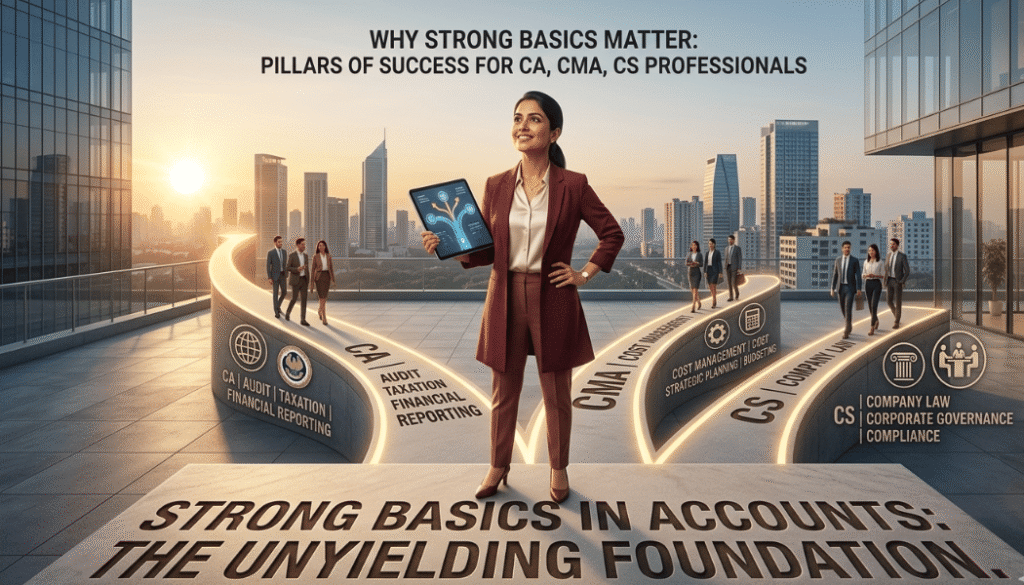
Accounting concepts are repeatedly tested at every level of CA, CMA, and CS programs. Fundamental topics such as:
serve as the base for understanding advanced subjects like auditing, taxation, corporate finance, and strategic management.
Without clarity in these basics, students often struggle to understand higher-level concepts, making their professional studies much more challenging.
Strong accounting fundamentals help students understand why financial transactions are recorded, not just how they are recorded. This deeper conceptual clarity is essential for solving practical and analytical questions.
In professional exams, students are expected to analyze scenarios, interpret financial data, and apply accounting principles logically. A clear understanding of accounting concepts allows students to approach problems confidently and accurately.
Professional exams require a combination of accuracy, speed, and logical reasoning. Students with a strong accounting base generally perform better in:
A solid foundation helps students solve questions faster and reduces exam stress, giving them a competitive advantage.
Accounting knowledge is not limited to one subject. It directly supports many other subjects within professional courses, including:
When students lack strong accounting fundamentals, they often find it difficult to understand these interconnected subjects, which can impact their overall academic performance.
Accounting knowledge is equally important beyond exams. Professionals working in finance and corporate sectors rely on accounting principles in their daily work.
Career roles that heavily depend on accounting knowledge include:
Employers value professionals who can interpret financial statements, analyze business performance, and make informed financial decisions.
Students who strengthen their accounting fundamentals during Class 11 and 12 Commerce or during graduation often find professional courses much easier to manage.
Early preparation offers several advantages:
Starting early allows students to build confidence and develop a strong academic base before entering advanced professional studies.
For students aiming to pursue careers in Chartered Accountant (CA), Cost and Management Accountant (CMA), or Company Secretary (CS), mastering accounting fundamentals is essential.
A strong foundation in accounting simplifies learning, improves exam performance, and prepares students for real-world financial responsibilities. Investing time in understanding the basics early can significantly increase the chances of success in professional courses and build a strong career in finance and corporate management.